 Dayton Tuckpointing
 Brick Repair and Replacement in Dayton
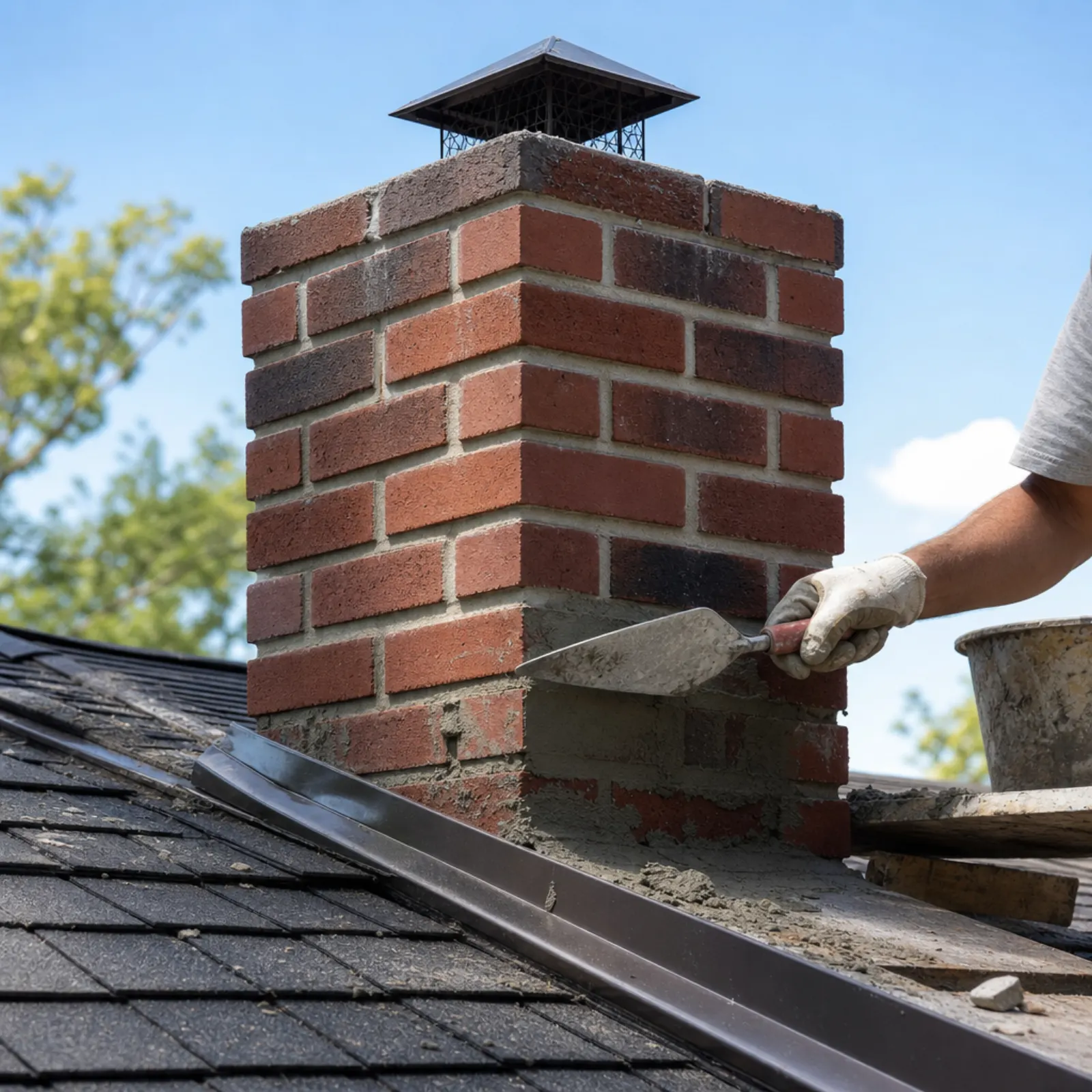
Brick repair in Dayton costs $20 to $40 per brick for spalled, cracked, or loose units cut out and replaced with matched brick in matched mortar, with small spot jobs at $300 to $900. The price of the brick is the small part. The skill is in getting a unit out without breaking its neighbors, matching a 130-year-old hand-pressed brick, and figuring out why it failed so the new one does not. Send photos and we can tell you which of those you are dealing with.
How brick fails in Dayton
Spalling from the wrong mortar. This is the big one on the older stock. Brick laid before about 1930 in the Oregon District, St. Anne’s Hill, Huffman, South Park, Dayton View, Grafton Hill, and Oakwood went up in soft lime mortar. When a later crew repointed it with hard Portland cement, the mortar became stronger and less permeable than the brick. Preservation Brief 2 documents what follows: moisture that used to evaporate through the joints stays in the brick, freezes, and pops the face off in sheets. Once the fired skin is gone, the softer core absorbs water faster and the brick crumbles from the face inward. You can spot this failure from the street: sound mortar joints standing proud between dished, flaking brick. The fix is replacing the spalled units and repointing the wall in a compatible lime mortar; anything else is a loop.
Spalling from water. A failed chimney crown, open joints, a leaking gutter, or a sill without a drip all put water into the wall. Ohio’s roughly 110 freeze-thaw cycles a year do the rest. Chimneys, parapets, and the courses under sills go first. See the chimney page for why the crown is the first thing to check.
Cracked brick from movement. A rusting steel lintel expands and lifts the brick above it, cracking units along a step line from the window corner. A foundation riding the Miamian clay, which swells and shrinks with a water table that sits 2.5 to 3.5 feet down each spring, cracks brick along a diagonal. Replacing cracked brick without addressing the lintel or the footing means the new brick cracks on the same line. The lintel page explains how to tell the two apart.
Loose brick. Mortar that has completely washed out leaves brick sitting on nothing, most often at chimney tops, parapet caps, and the brick rowlock sills on mid-century ranches. Those units get reset in fresh mortar; if the mortar around them is gone too, it is a repointing job with some resets.
Salvage cuts and old openings. Dayton’s older houses have had windows bricked in, porches removed, and additions cut through. A bricked-in opening done in the wrong brick and mortar reads as a patch and often fails at its edges because it was never toothed into the original wall. Re-toothing those edges is brick work, and it is what makes the patch disappear.
Matching the brick
Modern brick is the easy case. The hard, uniform, machine-made brick on Kettering’s postwar streets, the 10,707 single-family homes Huber Homes built in Huber Heights from 1956 to 1992, and the Beavercreek and Centerville ranches is still made in similar colors or easily found at salvage.
Nineteenth-century brick is a different job. Springfield’s historic guidelines make the point for the whole region: before 1870, brick clays were hand-pressed and often unevenly fired, so a single wall carries a range of reds, oranges, and darker overburned units in slightly different sizes. Preservation Brief 2 says the same thing about replacement units: match the full range of the wall, not one brick. A good mason sources from salvage yards and reproduction makers, test-fits for size (old brick is often larger and less regular than modern modular), and places the replacements so their variation reads as part of the wall. On a Victorian front where the original brick is precious, turning a face-spalled unit around so the damaged side faces the cavity keeps the original material in place.
The mortar match matters as much as the brick match. A perfect brick set in a light gray Portland joint on a wall of buff lime joints shouts louder than a slightly-off brick in the right mortar. Sand color, binder, and joint profile are matched the same way they are for a repointing job.
How a replacement goes
- Find the cause. Wrong mortar, water, lintel, or settlement. The quote should name which and price that fix alongside the brick.
- Cut out the unit. The joints around the brick are cut with hand tools or a thin blade on the horizontals, the brick is broken out from the center, and the cavity is cleaned to sound mortar and brick on all sides. Neighbors are not chipped; a replacement that costs two more brick is not a repair.
- Match and set. The replacement is dry-fit, the cavity dampened, the bed and head joints buttered with matched mortar, and the unit pressed home. On a lime wall, the mortar is a lime mix; on a mid-century wall, Type N.
- Tool and cure. Joints are tooled at thumbprint hardness to the profile of the wall, then protected from freezing or baking while they cure.
What it costs
| Scope | Range |
|---|---|
| Brick replacement | $20 to $40 per brick |
| Small spot repair (a few units) | $300 to $900 |
| Service minimum (most crews) | $500 to $800 |
Salvage sourcing, height, and whether the cavity has to be re-toothed set the number. If more than a third of a chimney’s brick is spalled, replacing units stops making sense and a rebuild from the roofline is the honest quote. If the spalling runs across a whole elevation of old brick that was repointed in Portland, the right answer is unit replacement plus a full repoint in lime, and both are priced on the pricing page scales.
Historic district note
In Dayton’s 13 locally designated districts, exterior repairs need a Certificate of Appropriateness before work; there is no fee, and routine items can clear through the Preservation Officer. Replacing a small number of spalled bricks with matching units is precisely the kind of like-for-like repair that Springfield’s guidelines list as a staff-level Review Process B in its South Fountain and East High Street districts. The paperwork belongs in the schedule from the start.
Timing
Brick replacement follows the same rules as mortar: wall temperatures between 40 and 95 degrees, so mid-April through October in Dayton, between the April 16 and October 25 average freeze dates NWS Wilmington publishes. A loose brick at a chimney top is a fall-before-the-freeze job; a cosmetic spall at ground level can wait for spring.
Brick replacement is covered across Dayton and in Oakwood, Kettering, Centerville, Huber Heights, Beavercreek, and Springfield. Send a wide shot of the wall and a close-up of the worst brick with a coin for scale, and a photo of the joints around it.
Frequently Asked Questions
How much does brick replacement cost in Dayton?
$20 to $40 per brick, with small spot repairs landing at $300 to $900 once the service minimum is counted. Modern uniform brick from a 1970s ranch is the bottom of the range. Hand-pressed 1880s brick that has to be sourced from salvage to match color and size is the top.
Why are the faces popping off my brick?
Spalling, and in Dayton it almost always means water froze inside the brick. The usual culprits are a hard Portland repointing job on soft old brick, which traps moisture that used to leave through the joint, or open joints and a failed chimney crown letting water into the wall. Replacing the spalled units without fixing the mortar or the water source means replacing them again.
Can a spalled brick be turned around instead of replaced?
Sometimes. If only the face is damaged and the unit is otherwise sound, it can be cut out, flipped so the damaged side faces the wall cavity, and reset. Springfield's historic guidelines specifically recommend it, and it is the best way to keep original brick on a historic front. It only works on solid brick that is not fired differently on its two faces.
Will replacement brick match?
Closely, if it is sourced properly. Mid-century brick is usually still made or easily salvaged. Nineteenth-century brick varies in color, size, and texture within a single wall, so the match should be to the range of the wall rather than to one unit, and the mortar match matters as much as the brick match. On a weathered front, a new brick reads new for a season or two and then blends.
More masonry services
Areas we serve
- Dayton, OH
- Tuckpointing and Brick Repair in Beavercreek, Ohio
- Tuckpointing and Brick Repair in Fairborn, Ohio
- Tuckpointing and Brick Repair in Huber Heights, Ohio
- Tuckpointing and Brick Repair in Kettering, Ohio
- Tuckpointing and Brick Repair in Miamisburg, Ohio
- Tuckpointing and Brick Repair in Oakwood, Ohio
- Tuckpointing and Brick Repair in Springboro, Ohio
- Tuckpointing and Brick Repair in Springfield, Ohio
- Tuckpointing and Brick Repair in Troy, Ohio
- Tuckpointing and Brick Repair in Xenia, Ohio
- Tuckpointing, Stone, and Brick Repair in Centerville, Ohio